


The rules of visibility are being rewritten. In a world where AI answers are replacing traditional search results, it’s no longer enough to rank. Your brand also has to be known by the generative engines that are shaping the conversation.
That’s where generative engine optimization (GEO) comes in. GEO goes beyond optimizing pages. It ensures your brand is contextually understood and retrievable by AI tools including ChatGPT, Perplexity, Gemini, and Google’s AI Overviews. It’s about embedding your brand into the fabric of the digital sources that AI relies on to build its answers.
To help you navigate this shift, we’ve developed the RASE framework that outlines four essential pillars that define what it takes to be visible in an AI-first search landscape.
Relevance: From Keyword Matching to Contextual Alignment
The SEO Perspective
Traditional SEO relevance focuses on keywords and search intent, matching what people type into search bars with optimized page-level content. It’s about satisfying user queries with on-site content that earns clicks.
The GEO Perspective
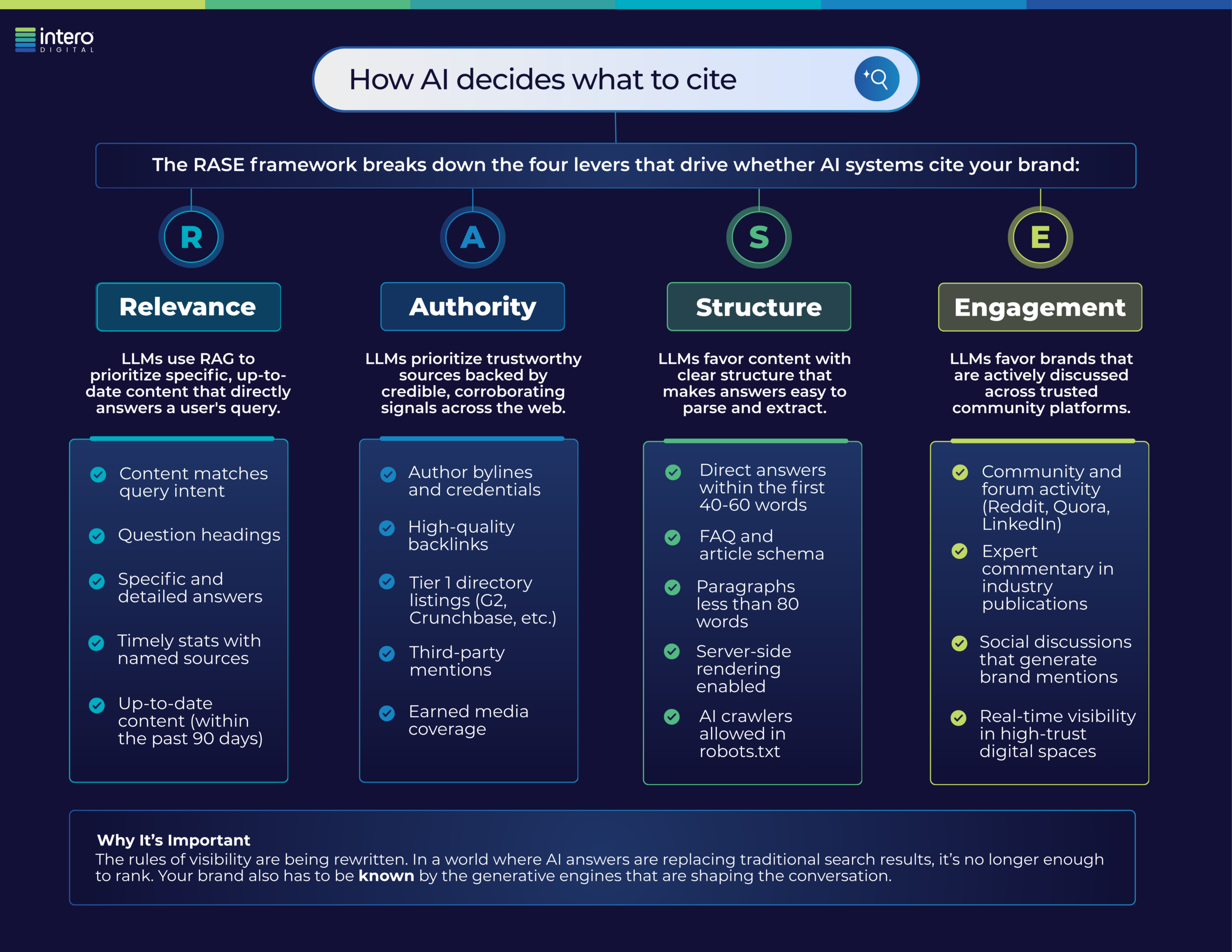
GEO relevance works differently because LLMs lean on retrieval-augmented generation (RAG) to pull specific, up-to-date content that directly answers what someone asked. It’s less about keyword density and more about whether your content is built to be pulled into an answer: content that matches query intent precisely, question-based headings, specific and detailed answers rather than vague overviews, timely stats attached to named sources, and pages refreshed within the past 90 days.
Recommendation: Create deeply structured content clusters around core topics and entities. Use consistent associations and link to reputable, AI-trusted sources. Answer questions directly and specifically, cite named sources with current data, and keep key pages updated on a quarterly cadence at minimum.
Authority: From Backlinks to Brand Mentions and Entity Associations
The SEO Perspective
Backlinks have long been the currency of SEO authority. Sites with strong link profiles and domain trust tend to rank higher.
The GEO Perspective
Backlinks still matter, but LLMs are also weighing trustworthiness signals that go beyond your link profile: author bylines and credentials, high-quality backlinks, listings on tier-1 directories like G2 and Crunchbase, third-party mentions, and earned media coverage. Think of it as semantic reputation. If AI sees your brand cited consistently alongside credible voices and corroborating sources across the web, it treats you as trustworthy.
Recommendation: Use digital PR, earned media, and thought leadership to generate citations and mentions in forums, publications, and content that AI indexes and values. Make sure bylines carry real credentials, and get your brand listed on the directories LLMs treat as trust signals.
Structure: From Indexability to Entity-Driven Retrieval
The SEO Perspective
Structure in SEO revolves around making content crawlable and indexable. That includes optimizing sitemaps, metadata, headings, and site health to aid rankings.
The GEO Perspective
GEO structure is about helping AI extract and parse your content easily. That means direct answers within the first 40–60 words of a page, FAQ and article schema markup, paragraphs under 80 words, server-side rendering enabled, and AI crawlers explicitly allowed in robots.txt. Miss any of these and even great content can become unreadable to the systems trying to cite it.
Recommendation: Lead with the answer, not the setup. Use schema markup (FAQ, Article, Organization, Person), keep paragraphs short and scannable, confirm server-side rendering is enabled, and double-check that your robots.txt isn’t blocking AI crawlers.
Engagement: From On-Site UX to Real-Time Participation
The SEO Perspective
Engagement typically measures how users interact with your content on-site, such as bounce rates, dwell time, and conversions, and it signals to search engines that your content is relevant.
The GEO Perspective
In a generative AI world, engagement means showing up in active, high-trust conversations. LLMs favor brands with visible community and forum activity on platforms like Reddit, Quora, and LinkedIn; expert commentary placed in industry publications; social discussions that generate organic brand mentions; and real-time visibility in the spaces your audience actually talks in.
Recommendation: Join niche conversations regularly. Stay visible in the digital spaces where your audience (and AI) go to learn and talk.
Why RASE Matters Now
GEO doesn’t replace SEO; it expands its scope. Traditional SEO built your storefront. GEO is how the AI neighborhood knows it exists and recommends it to others.
Without retrievability, even the best content can become invisible to AI. But when your brand shows up consistently, contextually, and authoritatively across the web, you do more than just rank. You reside in the minds of the machines that are shaping modern discovery.
From Rankability to Retrievability
Optimizing for GEO through the RASE framework means redefining what it means to “win” in search:
- Relevance is now about meaning, not just matching.
- Authority comes from trusted context, not just backlinks.
- Structure facilitates understanding, not just indexing.
- Engagement is earned in public discourse, not just on-site journeys.
If you want your brand to be discoverable in 2026 and beyond, start thinking about not only who your content reaches, but also who it teaches.
Because in an AI-first world, being known leads to being found.
FAQ
What is the RASE framework for GEO?
The RASE framework is Intero Digital’s model for improving brand visibility in AI-generated answers from tools like ChatGPT, Perplexity, Gemini, and Google’s AI Overviews. It’s built on four pillars: relevance, or creating specific, current content that directly answers user queries; authority, or earning credibility through bylines, backlinks, directory listings, and third-party mentions; structure, or formatting content so AI can easily parse and extract it; and engagement, or maintaining an active presence in trusted community and industry conversations.
Does GEO replace SEO?
No. GEO expands the scope of SEO rather than replacing it. Traditional SEO still matters for crawlability, rankings, and on-site performance, and many of its fundamentals, like backlinks and search intent, carry over into GEO. What GEO adds is a focus on retrievability: making sure AI engines understand your brand in context, trust it as a source, and can pull your content into the answers they generate.
How do you make content easier for AI engines to cite?
Lead with a direct answer, use question-based headings, and keep paragraphs concise so key points are easy to extract. On the technical side, add FAQ and Article schema markup, confirm server-side rendering is enabled, and make sure your robots.txt file isn’t blocking AI crawlers. Supporting claims with current statistics from named sources and refreshing key pages at least quarterly also improves the odds of being cited.
Ready to Stop Guessing and Start Growing?
Let’s build a digital marketing program that aligns with your revenue goals and strengthens your bottom line.