

Generative Engine Optimization (GEO) Services
Get discovered across the AI search ecosystem.
AI search tools like ChatGPT, Gemini, and Perplexity are generating answers your customers trust, with or without your brand in them. Intero GRO™ is built to change that. Our strategic framework helps you earn citations and trusted visibility in AI search to make sure your brand shows up front and center when buyers are researching, comparing, and deciding.
What Is Generative Engine Optimization?
Generative engine optimization (GEO) is the practice of making your brand easier for AI platforms like Google AI Overviews, ChatGPT, Gemini, and Perplexity to cite, recommend, and mention when people ask questions.
At its core, GEO strengthens how your brand and its key entities (products, services, people, locations, categories, and ideas) are defined, connected, and reinforced across the web. That matters because large language models (LLMs) don’t behave like traditional search engines. They don’t just rank pages. They retrieve information, interpret context, and generate answers.
Traditional SEO relies on crawlability, indexability, and rankability. GEO adds a fourth pillar: retrievability, or how easily AI systems can find, trust, and prioritize your brand when generating a response.
LLMs synthesize information beyond your website, drawing from knowledge graphs, publisher sites, review platforms, directories, and forums. Appearing in AI-generated answers depends on how clearly your expertise is established, how consistently your brand is represented across trusted sources, and how well your content is structured for machine interpretation.
Your audience is already on these platforms
- ChatGPT
- Google AI Overviews
- Google AI Mode
- Gemini
- Perplexity
- Microsoft Copilot
- Claude
- Meta AI
- xAI Grok
- Bing AI Summaries
Why GEO Matters: The AI Search Shift
GEO helps make sure your brand is visible across the AI-driven search experiences your audience is already using.
Search behavior is getting longer, smarter, and more conversational.
Instead of typing a few keywords into a search bar, users are asking platforms like ChatGPT detailed questions to research products, compare companies, and evaluate solutions. Hundreds of millions of people use these tools every week, generating billions of prompts that shape discovery and decision-making.
AI-generated answers are becoming the new front door to discovery.
For a growing share of users, AI-driven search is already the first place they turn for information, and adoption is moving faster than most brands have adapted.
AI visibility is shaped by signals your brand can influence.
These platforms pull from sources they view as authoritative, trustworthy, and easy to interpret. Signals like E-E-A-T, mentions in trusted publications, structured data, and clearly defined entities all affect whether your brand appears in AI-generated answers and how it’s represented when it does.
Zero-click behavior is accelerating.
More questions are being answered directly inside AI interfaces and search results, often before a user ever reaches a website.
Traditional rankings no longer tell the whole visibility story.
A page can rank well in organic search and still lose ground if an AI platform answers the question without citing, mentioning, or recommending your brand.
A GEO Agency That Creates Business Value
AI is changing how people find answers. Your brand needs to be part of those answers. Your audience isn’t just typing queries into Google anymore. They’re asking ChatGPT, getting summaries from Perplexity, and relying on AI-generated overviews to make decisions, often without ever clicking a link. The brands that win are the ones being cited, quoted, and surfaced inside those AI responses.
To compete now, brands need a GEO partner that understands how large language models discover, evaluate, and elevate content: how to build authoritative structure, semantic depth, and content systems that earn citation across AI-powered platforms.
What GEO Delivers for Your Brand:
- Get Cited in AI-Generated Answers: Be present where decisions are actually being made: inside the AI responses your audience trusts to summarize the web, recommend solutions, and answer complex questions.
- Reach High-Intent Audiences Through Conversational Search: Connect with buyers at the moment they're asking through prompt-aligned content strategy, entity optimization, and authoritative signals that make your brand the answer that AI models reach for.
- Turn AI Visibility Into Measurable Business Outcomes: Go beyond impressions. Build an organic presence that drives qualified traffic, supports conversions, and compounds authority over time as AI search continues to grow.
How Our Experts Drive Your Success
The brands that lead in AI search are not there by accident. They’ve built clear entity signals, strong authority, and consistent representation across the web. Our GEO approach focuses on making sure AI platforms understand your brand well enough to trust it, surface it, and cite it in the moments that matter.
Christina Adame
President of Search and Paid Media, Intero Digital

A Purpose-Built Framework for AI Search Visibility
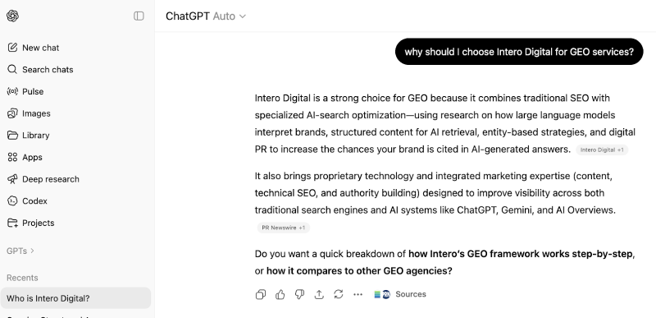
Intero GRO™ (Generative Response Optimization®) is our proprietary GEO framework built to help brands earn visibility in AI-powered search. It combines research, strategy, and execution across SEO, content, digital PR, and cross-platform engagement to strengthen how your brand is understood, trusted, and surfaced in AI-generated answers.
AI Visibility Audit, Research, and Analysis
Every GEO engagement starts with a structured diagnostic of how AI platforms currently see your brand. We assess your presence in Google AI Overviews and evaluate how platforms like ChatGPT, Gemini, Perplexity, and Copilot describe your company, which competitors show up alongside you, and which sources are shaping those responses.
From there, we analyze your visibility across both traditional and AI-generated search to uncover the signals influencing discovery, including authority indicators, entity relationships, priority topics, audience questions, and emerging themes. The result is a sharper understanding of where your brand stands now, where visibility gaps exist, and where the biggest GEO opportunities are.
Content Ecosystem Planning
Once the initial research is complete, we take a hard look at your existing content ecosystem and map out how it needs to evolve to build stronger authority and improve retrievability in AI search.
This phase includes:
• Content inventory and performance analysis.
• Topic cluster architecture and mapping.
• Internal linking framework design.
• Identification of content gaps, consolidation. opportunities, and expansion areas.
The outcome is a clear content blueprint that shows how your pages should be structured, connected, and expanded so AI systems can better understand your brand, interpret topic relationships, and retrieve the right information when it matters.
GEO Strategy and Road Map
Next, we turn research into action with a prioritized road map built around your goals, market, and competitive landscape. Instead of defaulting to a one-size-fits-all list of deliverables, we identify the opportunities that are most likely to move visibility and define how to sequence work across channels for the greatest impact.
The road map outlines:
• Priority entities and topic areas.
• Content initiatives and authority-building opportunities.
• Coordination across SEO, owned media, and earned media.
• Quarterly execution priorities and success metrics.
The result is a strategic blueprint that keeps GEO execution focused, aligned, and tied to measurable outcomes.
AI Search Optimization and Implementation
This is where strategy becomes execution. We implement the signals LLMs use to evaluate your brand, trust your content, and decide whether to surface you in AI-generated answers.
Every initiative is built around the visibility gaps and opportunities uncovered during research so the work can be targeted, not templated.
This work spans:
• Content structuring for AI retrieval.
• Entity-based content strategy.
• Technical SEO and accessibility.
• Digital PR and strategic brand mentions.
• Multimedia content development.
• Community engagement and brand reputation signals.
AI Visibility Tracking and Strategy Refinement
AI search doesn’t sit still, and neither should your strategy. LLM updates, platform shifts, and new AI search experiences are constantly changing how brands get surfaced, cited, and described. That’s why we continuously monitor the signals that matter, including AI citation performance, brand mention trends, LLM referral traffic, and visibility changes across platforms.
Those insights feed directly into ongoing strategy refinement. As the landscape evolves, we adjust your approach to stay aligned with both platform behavior and your business goals.
You get clear reporting on where visibility is growing, where competitors are gaining momentum, and how platform changes might be affecting your position. The result is a GEO strategy built to be durable enough to last and agile enough to keep up.
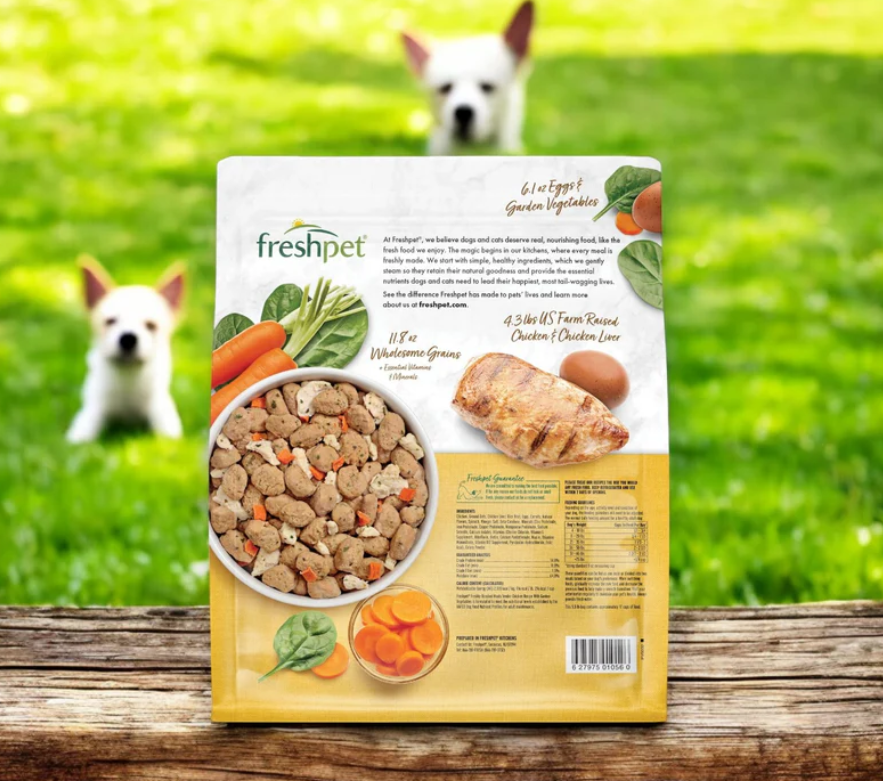
From the start, Intero Digital quickly and expertly shifted Freshpet to a GEO-first strategy. They've continually met & exceeded the challenges I've fielded to them, from establishing foundational analytics in a space with no precedent for measurement, to correcting the results of specific prompts where misinformation about Freshpet had previously gone unchecked/unchallenged. Their deep technical expertise and ability to find solutions to brand new problems have quickly made them an indispensable partner for us.
Why Intero Digital for GEO?
A future-focused AI visibility strategy built on entity authority, content intelligence, and modern search expertise
Our approach to GEO is an integrated visibility system. Intero GRO™ connects entity development, content structuring, authority building, and technical optimization into one coordinated program tied to the business outcomes that matter. We don’t just optimize for today’s AI search platforms. We also strengthen the foundational signals (entity clarity, E-E-A-T, brand authority, and content structure) that help your brand earn visibility now and stay competitive as the generative search ecosystem continues to evolve.
Proprietary Intero GRO™ Framework
Integrated SEO, Content, and Digital PR Execution
Entity-First Strategy
Transparent AI Visibility Measurement
Sustainable Optimization
The Intero Retrievability Framework for AI Search Optimization
Retrievability is what determines whether AI can find, understand, and trust your brand when generating an answer. At Intero Digital, we break that down into connected pillars: relevance, authority, structure, and engagement. Every GRO™ strategy is built to strengthen all four.
LLMs use RAG to prioritize specific, up-to-date content that directly answers searchers' queries.
- Content matches query intent
- Question headings
- Specific and detailed answers
- Timely stats with named sources
- Up-to-date content (within the past 90 days)
LLMs prioritize trustworthy sources backed by credible, corroborating signals across the web.
- Author bylines and credentials
- High-quality backlinks
- Tier 1 directory listings (G2, Crunchbase, etc.)
- Third-party mentions
- Earned media coverage
LLMs favor content with clear structure that makes answers easy to parse and extract.
- Direct answers within the first 40-60 words
- FAQ and article schema
- Paragraphs less than 80 words
- Server-side rendering enabled
- AI crawlers allowed in robots.txt
LLMs favor brands that are actively discussed across trusted community platforms.
- Community and forum activity (Reddit, Quora, LinkedIn)
- Expert commentary in industry publications
- Social discussions that generate brand mentions
- Real-time visibility in high-trust digital spaces
Are You Up to Par?
Check off the signals your brand already has and see where the gaps are.
What’s Included in Intero GRO™ AI Search Optimization Services?
Intero GRO™ combines technical precision, strategic content development, off-site authority building, and AI-specific optimization to help brands earn and sustain visibility in AI search.
AI Search Visibility Audits
We start with a comprehensive diagnostic of how AI platforms currently understand, represent, and cite your brand. That includes identifying which queries trigger AI Overviews in your space; how ChatGPT, Gemini, Perplexity, and Copilot describe your business; which competitors are being surfaced alongside you; and where the biggest visibility opportunities are.
Entity Optimization
LLM search is entity-first, so your brand needs to be clearly defined everywhere AI looks. We align your entity signals across your website, structured data, and trusted third-party sources to help AI systems understand what your brand is known for, how it connects to key topics, and when it should be surfaced. In some cases, that includes knowledge graph development and Wikipedia strategy.
Theme Opportunity Analysis
You can’t win visibility in conversations your brand never enters. We identify the prompts, questions, and themes your audience is already taking to AI platforms. Then, we pinpoint where your brand is missing, underrepresented, or losing ground to competitors. That research shapes the content and authority strategy that follows.
Conversational Content Optimization
AI systems don’t just scan for keywords. They also evaluate meaning, structure, and relevance. We optimize content for answer-ready formatting, semantic clarity, structured Q&A, and the conversational patterns AI platforms favor. That includes optimization for Google AI Overviews, direct-answer formats, featured snippets, and the contextual signals LLMs use to interpret meaning.
Entity Based Content Strategy
We build content around the entities, topics, and relationships that define your brand’s expertise. Topic clusters, pillar pages, and internal linking strategies are designed to strengthen topical authority and make those relationships easier for AI systems to understand. Entity gap analysis helps uncover missing concepts in your content ecosystem and close them in ways that support both AI visibility and organic search performance.
E-E-A-T Optimization
AI systems lean heavily on experience, expertise, authoritativeness, and trustworthiness (E-E-A-T) when deciding what to cite. We strengthen the signals that support credibility, including author bios, verified credentials, content freshness, and clear authorship.
Structured Data
We implement and refine schema markup to help AI systems connect your content to known entities, understand your offerings more clearly, and surface accurate brand information in AI-generated responses and rich results.
Technical Optimization
A strong technical foundation makes your content easier for search engines and AI systems to crawl, interpret, and retrieve. We address crawl and indexability issues, monitor AI crawler access, optimize crawl paths, implement semantic HTML and clean metadata, and support the performance and accessibility standards modern AI systems expect.
Digital PR & Brand Mentions
AI visibility isn’t built on backlinks alone. It’s also built on context. LLMs learn from the broader web, including publications, forums, datasets, and industry conversations. We help secure meaningful brand mentions and citations in the high-authority sources AI systems reference so your brand can be consistently associated with the right topics, entities, and terms.
Multimedia Content
AI search is increasingly multimodal, pulling from images, video, and structured visuals alongside text. We develop multimedia assets with retrievability in mind, using optimized metadata, alt text, schema, and Open Graph tags to improve how AI systems preview, interpret, and surface visual content. Platform-ready formats for YouTube, Instagram, and AI-powered search results help extend your visibility across more discovery surfaces.
Community Engagement
AI doesn’t just learn from your website. It also learns from where your brand is discussed. Reddit, Quora, industry forums, social platforms, and other community-driven spaces all contribute to how AI interprets your authority and relevance. We build community engagement strategies that place your brand in high-signal conversations, maintain entity consistency across platforms, and strengthen the broader signals that influence retrievability.
AI Visibility & Citation Monitoring
We track how, where, and when AI platforms mention your brand and cite your content. That includes monitoring citation share, brand perception across LLMs, LLM referral traffic, and visibility trends over time. This closes the loop between optimization activity and measurable outcomes while giving us the data needed to keep refining your GRO™ strategy as the generative search landscape continues to evolve.
Technology That Powers AI Search Optimization
Intero Digital combines proprietary strategy with industry-leading technology to execute GEO with precision and at scale. We use a modern AI visibility stack to monitor how answer engines interpret your brand, where competitors are gaining ground, and which signals are influencing citations across generative search.
Tools like Profound help power that work by tracking brand visibility across AI platforms, analyzing prompt-level performance, and surfacing the sources shaping AI-generated answers. That gives our team a clearer view of how your brand is being represented across platforms like ChatGPT, Perplexity, Gemini, and other AI-driven search experiences.
We pair those insights with Intero Digital’s expertise across SEO, content, technical optimization, and digital PR to turn AI visibility data into action. The result is a smart, measurable GEO strategy built to improve citations, strengthen authority, and expand your presence in AI search.
A Tailored GEO Strategy Built for Your Industry
We tailor GEO strategies to how buyers in your specific market use AI for research and discovery.

Retail

Real Estate

Manufacturing

Home Services

Restaurants and Food

Healthcare

Financial Services

Legal

SaaS and Technology

e-Commerce

Education

Construction
Real Results; Real AI Visibility Growth
 Kitchen Equipment
Challenge
Improve AI search visibility for queries related to premium cutting boards and prep tables
What We Did
AI-optimized product data and structured citations, entity strengthening and knowledge graph expansion, and AI Overviews and generative search targeting
Results
5,665% increase in generative search visibility, 189% year-over-year growth attributed to AI-driven referrals, 111% increase in total views year over year, and 66% growth in engaged users from AI-driven traffic
 Manufacturing
Challenge
Improve AI-driven visibility, traditional search visibility, and the bottom line
What We Did
Content strategy, SEO fundamentals improvements, and optimizing schema across the Knowledge Graph to strengthen entity association
Results
Went from zero presence in Google AI Overviews to 1,200+ appearances year over year, as well as a 34% increase in Page 1 rankings and a 24% organic revenue boost
 Technology & Information Services
Challenge
Solidify the client as the go-to resource for AI-driven learning queries
What We Did
Educational content structuring for AI retrievability, entity strengthening and knowledge graph optimization, and zero-click optimization
Results
1,184% increase in generative search visibility, 39+ placements in AI Overviews and zero-click results, 1,214% spike in engagement events from AI-referred users, and 55% improvement in session quality
You’ve Got GEO Questions. We’ve Got Answers.
Generative engine optimization (GEO) is the practice of making your brand easier for AI-powered search platforms, such as ChatGPT, Google AI Overviews, Perplexity, Gemini, and Microsoft Copilot, to understand, trust, and surface in the answers they generate.
Unlike traditional SEO, which focuses on rankings in a list of links, GEO is about earning citations, mentions, and recommendations in AI-generated responses. It’s built for a retrieval-driven environment where visibility depends on entity clarity, E-E-A-T, content structure, and brand authority across the web.
SEO is built to improve visibility in traditional search results. GEO is built to improve visibility in AI-generated answers.
Traditional SEO focuses on rankings, relying on signals like keywords, backlinks, and technical site health to help pages perform in search engine results pages (SERPs). GEO focuses on citation, mention, and recommendation, relying more heavily on entity clarity, E-E-A-T, brand authority, and content structure to help AI platforms decide what to surface.
The two are not competing strategies. They work better together. Strong SEO creates the technical and content foundation GEO depends on, while many GEO improvements also strengthen organic search performance. Brands investing in both build stronger visibility across every search surface.
GEO is important because AI-driven search is quickly becoming a primary way people discover brands. Google AI Overviews now appear above organic results for millions of queries, while platforms like ChatGPT, Perplexity, and Gemini are increasingly being used to research products, compare vendors, and shape purchase decisions.
That creates a visibility gap many brands don’t even realize they have. If your business isn’t optimized for AI retrieval, you’re not just losing clicks to competitors; you might be getting left out of the answer altogether. GEO helps make sure your brand is part of the recommendations, comparisons, and responses that are influencing decisions upstream.
E-E-A-T stands for “experience, expertise, authoritativeness, and trustworthiness.” It began as a framework for evaluating content quality in traditional search, but the same signals now play a major role in how AI systems decide which sources are credible enough to cite.
That matters even more in high-stakes industries like health, finance, and legal, where LLMs are more cautious about surfacing unverified or low-trust information. GEO-focused E-E-A-T work strengthens the signals AI platforms look for, including author credentials, expert bios, content accuracy, freshness, authoritative third-party mentions, and the entity signals that reinforce your brand’s credibility.
Entity optimization is the process of making sure your brand is clearly defined and consistently understood across the web. It strengthens the signals that tell AI systems who you are, what you do, and which topics your brand should be associated with.
That matters because LLMs rely heavily on entity-based retrieval. They don’t just look for matching keywords. They identify brands, products, services, people, and concepts as entities and then determine which ones are most relevant to a given query. Entity optimization supports that process through structured data, consistent third-party brand signals, knowledge graph development, and content built around the topics and relationships that define your expertise.
GEO tends to follow a similar curve to SEO: Some gains can happen early, but stronger citation visibility and authority signals build over time.
Technical and structural improvements, like better AI crawler access, cleaner content architecture, and structured data, can improve retrievability relatively quickly.
The longer lift comes from the signals that compound. Entity optimization, E-E-A-T development, and brand mention building all strengthen authority over time and make your brand more likely to be cited consistently across AI platforms. Brands that invest early aren’t just chasing short-term visibility; they’re building an advantage that will get harder to catch as the generative search landscape continues to mature.
GEO works by strengthening the signals AI systems use to decide what to trust, retrieve, and include in their answers. That means clearly defining your brand as an entity across the web, structuring content so it’s easier for AI to interpret, reinforcing E-E-A-T through credible content and verified expertise, earning mentions and citations in trusted third-party sources, improving technical accessibility, and using structured data to connect your content to known entities.
The outcome is a brand that’s easier for AI platforms to understand, more credible to cite, and more likely to be surfaced in the answers your target audience sees.
These terms are closely related, and in practice, there’s a lot of overlap. The difference usually comes down to what part of AI-driven discovery each term emphasizes.
• GEO (generative engine optimization) focuses on helping your brand appear in AI-generated answers across platforms like ChatGPT, Google AI Overviews, Perplexity, and Copilot. It’s the broadest and most commercially useful term for optimizing visibility in generative search.
• AEO (answer engine optimization) puts more emphasis on winning direct answers. It’s typically used to describe content structured for question-and-answer formats, featured snippets, and AI responses where the goal is to become the answer, not just rank for the query.
• AI SEO is an umbrella term. It’s often used more loosely to describe any strategy designed to improve visibility across AI-influenced search experiences, including both traditional search features and generative platforms.
• LLMO (large language model optimization) focuses more specifically on how large language models retrieve, interpret, and cite information, with an emphasis on entity clarity, structure, trust signals, and sourceability.
GEO targets any platform where AI-generated answers influence how people discover brands. That includes ChatGPT, Google AI Overviews, Google AI Mode, Gemini, Perplexity, Microsoft Copilot, Claude, Meta AI, xAI Grok, Bing AI-powered summaries, DuckDuckGo AI Chat, and other emerging LLM-powered search experiences.
Each platform works a little differently. They vary in how they retrieve information, which sources they cite, and which trust signals they prioritize. That’s why Intero GRO™ is built to optimize across the full AI search ecosystem, not chase one platform at a time.
Brand mentions and citations are important for GEO because they help AI systems decide whether your brand is credible enough to surface. Much like backlinks help search engines assess authority, mentions in trusted sources help large language models understand what your brand is known for, how it relates to relevant topics, and whether it’s worth citing.
That matters because LLMs don’t rely on your website alone. They learn from the broader web, including publications, forums, datasets, reviews, and other third-party sources. When your brand is consistently mentioned alongside the right entities, topics, and industry terms in places AI systems treat as authoritative, it strengthens the recognition and trust signals that increase your chances of being cited in AI-generated answers.
GEO performance is measured using a mix of AI-specific visibility signals and traditional performance data. That includes how often your brand is cited across target AI platforms, how frequently it’s mentioned in LLM responses, the sentiment and context of those mentions, your citation share relative to competitors, LLM referral traffic in Google Analytics, visibility in Google AI Overviews for priority queries, and how your brand is represented across platforms like ChatGPT, Gemini, and Perplexity.
Intero Digital tracks these signals through platforms like BrightEdge AI Catalyst, Profound, Semrush, and other platform-specific monitoring tools and then reports on them with the same transparency, rigor, and business focus we bring to traditional SEO.
Yes, absolutely! Many of the signals GEO strengthens also support traditional SEO. E-E-A-T, structured data, content clarity, entity authority, and high-quality brand mentions all help search engines better understand, trust, and rank your content.
Technical improvements made for AI accessibility, like stronger crawl paths and cleaner site structure, also support Google crawlability. And content optimized for AI retrieval often performs better in features like featured snippets and People Also Ask. When SEO and GEO work together, the result is stronger visibility across both traditional search and AI-driven discovery.