


If your Amazon sales chart looks more like a mountain range than a steady line, you already know the feeling. A few months decide your whole year, and the rest is preparation or recovery. Now add AI to the mix, changing how shoppers find products and how your ads get served, and the margin for error gets even thinner.
That’s the challenge we dug into in our latest webinar: “Losing the Steering Wheel: AI, Seasonality, and Forecasting on Amazon.” My colleague Jessica Ward, VP of strategy here at Intero Digital, and our client Jeremy Spencer, director of operations at Snowie, joined me for the conversation.
My team has partnered with Snowie since 2020, so I’ve watched its seasonality up close. Little Snowie, the Salt Lake City manufacturer’s home shaved ice machine, sees roughly a 12-times difference between its slowest month and its June or July peak. When that much of your year rides on a few months, you can’t afford a forecasting miss, an empty FBA shelf, or a listing that AI doesn’t understand.
Here are four questions we touched on during our conversation that I think every seasonal seller should be able to answer before their next peak:
How Is AI Changing the Way Shoppers Find Products on Amazon?
Shoppers are increasingly finding products by asking Alexa for Shopping (formerly Rufus) questions instead of typing keywords, which means your listing has to answer those questions directly.
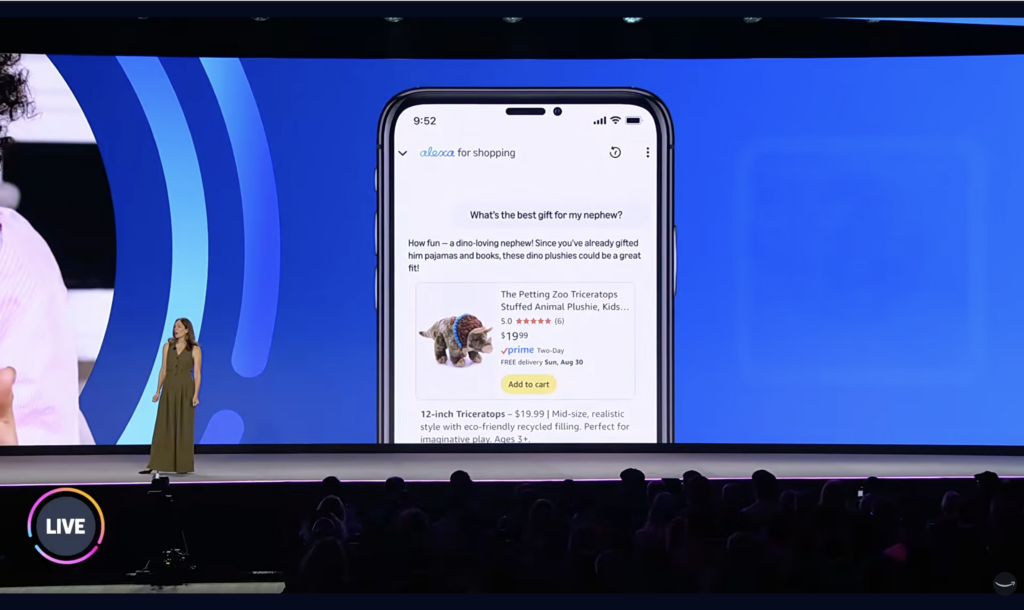
One example from Amazon Accelerate 2026 stuck with me. A shopper asked, “What’s the best gift for my nephew?” There was no age, no product type, and none of the keywords sellers usually optimize around. The AI assistant filled in the gaps using what it knew about the shopper and recommended a triceratops plushie because that product’s listing answered the questions a gift buyer would have: how big it is, how kids play with it, and what ages it’s for.
AI is reading your listing and deciding whether it’s a good fit. In other words, your listing now behaves a lot like a keyword.
That doesn’t mean you have to rewrite everything. Keyword ranking and conversion fundamentals still matter, so build on what you already have. Here’s how to optimize for Alexa for Shopping:
- Make your title, bullet points, and A+ Content clearly say who the product is for, when to use it, and why it’s the right pick. Those are the sections the assistant pulls from.
- Mine your reviews and Q&A section for the questions shoppers are already asking; then, incorporate the answers into your main copy. Keep answering questions in the Q&A section, too.
- Adjust for the season. What shoppers ask about in December isn’t what they ask about in July.
- Test it yourself. Ask Alexa for Shopping the kinds of questions your customers would ask. If your product doesn’t come up, look at what does and why the assistant chose it.
What Are Amazon Sponsored Prompts, and How Should You Manage Them?
Sponsored prompts are AI-generated prompts that Amazon writes from your titles, bullet points, and A+ Content and serves through Sponsored Products and Sponsored Brands ads, and they’ve been on by default since March. You pay for those clicks the same way you pay for keyword clicks.
The good news is that you have visibility and control. Inside any Sponsored Products or Sponsored Brands campaign, open the ad group and go to the prompts tab to see which prompts are getting clicks. From there, manage them like any other keyword: Pause the ones that are off-brand, less relevant, or spending without selling, and use the ones that perform well as feedback for refining your listing copy.
One limit: The report only shows prompts that have received clicks, so your own testing in the shopping assistant still matters.
Amazon has also introduced auto-optimization for campaigns, which adds keywords, pauses underperformers, and adjusts for seasonal movement on its own. It’s capable, but it’s built around Amazon’s goals. Your main lever is max bid, and the tool doesn’t know your margins or ACOS targets. That’s why my team doesn’t use Amazon’s native auto-optimization. When automation makes sense, we use a third-party tool, and for certain keywords, manual management is still the better choice.
Why Isn’t Amazon’s Inventory Forecast Enough for Seasonal Brands?
Amazon’s forecasting tool only sees your sales history, its own demand forecast, and your inventory position, so it misses the lead times, promotions, and launches that drive seasonal demand.
At Amazon Accelerate, a speaker asked the room who used Amazon’s restock recommendations. A few hands went up. When he asked who wished they were better, nearly every hand in the room went up. Amazon’s own answer was that its tools only know what they’ve been told.
That’s the core gap for seasonal sellers. Amazon’s forecasting looks at your sales history, its own demand forecast, and your inventory position. It doesn’t know your manufacturing lead times, promotions on or off Amazon, budget changes, product launches, or whether Prime Day is moving up a month. And it’s built for steady demand, not a 12-times swing.
Amazon’s forecast is a fine starting point, but it shouldn’t be your final answer. Here’s how I recommend closing the gap before peak season:
- Generate your own number. Start with Amazon’s forecast and layer in everything that only you know.
- Check FBA capacity well in advance.
- Leave enough time to ship. Forecasting tools struggle with physical constraints. Only about 75 Little Snowie machines fit on a pallet, for example, so getting enough units into FBA has to happen in waves over several months.
- Plan your shipping windows precisely. The more carefully you map the ramp-up, the smoother your execution will be.
Precision matters because both kinds of misses are expensive. Stockouts hurt your rankings, and overstock brings storage and removal fees. For Snowie, summer inventory gets decided in the winter.
Jeremy shared what this looks like operationally. During Snowie’s early growth on Amazon, FBA orders sometimes took two to four weeks to leave the building, and listings ran out of stock during peak months. His team overhauled its process, set an internal goal of having any FBA shipment palletized within one week of the request, and created a dedicated backstock area for Amazon inventory that its kitchen replenishes based on reorder reports.
He also shared a cautionary tale. Snowie’s three-pack syrup bundles sold strongly for years, so the team forecast production based on that momentum. Then, a competitor that could outspend them significantly moved in, and Snowie was left with pallets of inventory that never sold, a costly problem for a product with a shelf life. The lesson: Keep watching competitors and keyword trends instead of assuming last year’s demand will repeat.
AI still has a role here. I find it most valuable for crunching numbers and spotting trends, weighing trade-offs like stockouts versus tied-up cash, and reading signals around new products, competitor moves, and supply shifts. We use it to help with the math, but the judgment has to come from people who know the business.
How Can Seasonal Amazon Sellers Grow Beyond One Peak Season?
Seasonal brands can build steadier revenue by finding a second season, keeping ads running in the off-season, and expanding into new products or marketplaces.
One of the most common mistakes I see from single-season sellers is assuming there’s only one season and never looking for a second one.
For Snowie, that second season turned out to be Q4. Little Snowie makes a great holiday gift for families, so we shift strategy for the holiday rush by updating listing language around gifting, participating in Q4 promotions and deals, and moving ad targeting away from summer events and toward gift-giving.
That ties into a question I get a lot: Should you turn off ads in the off-season to save budget?
The answer? No.
Off-season ads aren’t about volume. They’re about rank preservation, keeping the oven hot until the next peak. Shift toward more defensive positions like brand terms, and use the lower-volume months to test keywords before peak season. As Jessica added, the same holds for Google Ads, where pausing and restarting can retrigger learning phases.
The slower months are also the time to refresh creative and listings, develop or retire products, and prep operations. Snowie used that time to build bundles, some of which still sell today.
Then, Snowie went a step further. Rather than only selling summertime and the holiday season better, Jeremy’s team built a new brand, Brewie, that uses Snowie’s manufacturing capabilities to make consumable products that can follow trends, like dirty soda and flavored water. Brewie launched in 2026 with water enhancers, gourmet flavoring syrups, and powdered cocktail and mocktail mixers, with hydration, coffee, cocoa, and lemonade lines planned for 2027.
Brewie launched direct-to-consumer first, with Amazon central to building brand recognition, and it’s already drawing B2B interest. The goal, Jeremy said, was a revenue stream that runs all year so the company doesn’t have to ride the same emotional rollercoaster every season.
Not every brand will launch a new product line, but the principle applies broadly. Look for ways to lengthen your season, find a hidden second one, or expand into new marketplaces.
AI is changing how shoppers find products on Amazon and how ads reach them, and those changes are already live in your account. But for seasonal brands, the hardest parts of the business still depend on human judgment: knowing what Amazon’s tools can’t see, planning inventory months ahead, and finding new ways to grow beyond a single peak.
If forecasting and planning feel like a challenge, check out the full recording of the webinar, where we shared even more insights and tips!
Ready to Stop Guessing and Start Growing?
Let’s build a digital marketing program that aligns with your revenue goals and strengthens your bottom line.