



Amazon is more competitive, and more complex, than ever. This guide breaks down how to leverage SEO, GEO, PPC, creative, and influencer strategies to win visibility, drive traffic, and convert more customers.
Amazon is no longer just a product search engine. It’s a full-scale performance marketing platform. Coming in third place behind Google and Facebook, Amazon ads account for 12.5% of total digital advertising revenue generated in the U.S. Amazon isn’t an isolated channel. It’s the centerpiece of an omni-channel retail strategy. Your Amazon performance now informs (and is informed by) your broader digital marketing, e-commerce, and GEO visibility playbook across platforms.

To compete and convert in this fast-moving environment, top brands don’t just optimize listings. They orchestrate a full-funnel strategy across Amazon SEO, Sponsored Products, DSP, A+ Content, influencer integrations, and generative engine optimization (GEO) to appear in both search results and AI-generated product recommendations.
Whether you use Amazon Vendor Central or Amazon Seller Central, this guide outlines a proven framework that can help you integrate these channels effectively. You’ll learn how to maximize visibility through Fulfillment by Amazon (FBA), win the Buy Box, leverage Amazon Marketing Cloud (AMC), and build AI-friendly authority signals that boost discoverability on and off Amazon.
Table of Contents
- What Does Amazon Marketing Look Like in 2025?
- How do GEO and SEO Shape Amazon Visibility?
- Tactical Breakdown: 5 Core Pillars of Amazon Marketing
- How to Measure Amazon Success Beyond Rankings
- Amazon Marketing FAQ
What Does Amazon Marketing Look Like in 2025?
Amazon marketing in 2025 is no longer a checklist of siloed tactics. It’s an orchestrated, multi-entity system designed to maximize visibility, influence AI-generated discovery, and convert intent into revenue.
Winning brands are executing full-spectrum optimization that blends:
- A10 search performance, driven by keyword-rich titles, backend terms, and conversion-optimized A+ Content.
- AI retrievability achieved through consistent brand mentions, structured data, and external authority signals that train large language models (LLMs) to recognize and recommend your products.
- Midfunnel engagement via Sponsored Brands, Amazon DSP audience targeting, and strategic use of Amazon Attribution to track off-Amazon performance.
- Conversion engineering, where enhanced media, storefront merchandising, conversion rate optimization (CRO) best practices, and persuasive social proof (like user-generated content and reviews) reinforce trust and reduce friction.
- Operational excellence, including hybrid fulfillment models (Fulfillment by Amazon and Fulfilled by Merchant), Buy Box reliability, and inventory-level data integrations through Amazon Marketing Cloud (AMC).
- Smart pricing and promotions, as Amazon’s algorithms reward price consistency and promotional agility. Strategic pricing and promotion strategies, like lightning deals, coupons, and tiered discounts, influence Buy Box win rate, conversion rate during key retail windows, and product ranking within Sponsored Products and DSP.
The new frontier is generative engine optimization (GEO), the practice of shaping how AI models describe, recommend, and retrieve your brand in platforms like ChatGPT, Gemini, and Perplexity. Whether shoppers are asking a bot, reading a Reddit thread, or taking in a TikTok review, your visibility increasingly depends on how well your brand is understood, not just ranked.
How Do GEO and SEO Shape Amazon Visibility?
Traditional Search (SEO)
Amazon SEO in 2025 is still foundational, but it has evolved. It’s not just about keyword stuffing or optimizing product titles anymore. The most effective brands approach SEO as conversion-oriented, entity-aware optimization that aligns with Amazon’s A10 algorithm priorities.
Here’s what that means in practice:
- Product titles, bullet points, and backend search terms are built around both high-intent keywords and known product category entities.
- A+ Content and brand storefronts are structured as topical hubs that deepen customer understanding and increase dwell time.
- Conversion rate optimization (CRO) tactics, like review generation, pricing consistency, and clear benefits, boost organic rank by signaling high purchase intent.
- Amazon Attribution and Amazon Marketing Cloud (AMC) provide campaign-level insights that inform future keyword and creative decisions.
- Brands that dominate the Buy Box consistently invest in SEO not just to be found but to be chosen.
Generative Search (GEO)
While SEO helps you win traditional search rankings inside Amazon, GEO determines whether your brand shows up in AI-generated recommendations: the zero-click product suggestions that are increasingly powering discovery on ChatGPT, Gemini, Perplexity, and more.
To influence these large language models, brands must optimize for entity recognition and contextual authority:
- Get mentioned in trusted, topically relevant sources, such as industry publications.
- Use structured data (e.g., Product, Organization, and Review schema) to help AI interpret your brand’s attributes and positioning.
- Align with high-authority terms frequently searched by your audience, such as “skincare with clean ingredients” or “best running shoes for high arches.”
- Ensure consistency across ecosystems, from Amazon listings to external blogs, YouTube video transcripts, and social bios.
Example: A skincare brand that is frequently mentioned alongside terms like “clean ingredients,” “plant-based formulations,” and “EWG-verified products” in influencer reviews, editorial content, and customer reviews is more likely to be retrieved in AI-generated responses for prompts like “What’s the best clean skincare brand with natural ingredients and good Amazon reviews?”
In 2025, GEO is what helps AI recommend you, not just rank you. And the brands that invest in both strategies win the day.
Tactical Breakdown: 5 Core Pillars of Amazon Marketing
1. Amazon SEO: From Keywords to Entities
Amazon’s A10 algorithm still cares about relevance and performance signals, but in 2025, entities have entered the scene. Optimizing for structured concepts, recognizable attributes, and brand associations helps you dominate search and become retrievable by AI systems.
- Layer keywords with entity signals. Don’t only optimize for “immune support,” for example. Connect it to “organic vitamin C” or “clean-label supplements” to strengthen keyword relevance and entity association.
- Turn A+ Content into topic clusters. According to Steven Pope, founder of My Amazon Guy, “If your SEO stinks, it’s because you don’t have enough crawlable text in your A+ Content.” Use A+ Content to build semantic depth around product categories, ingredients, or use cases (e.g., “plant-based protein” → “gut health,” “recovery,” “vegan lifestyle”).
- Segment storefronts by buyer intent. Create curated experiences like “gifts for runners” or “kid-friendly immune boosters” to align with semantic searches and AI patterns.
- Build authority through backlinks and mentions. Secure off-Amazon citations from review blogs, YouTube creators, and Reddit discussions, which are key sources that LLMs reference for brand verification.
- Include strategic concepts like “Buy Box optimization,” “Amazon Attribution,” or “Seller Central strategies” in both product copy and external content to strengthen AI retrievability.
- Tap into competitor intelligence to identify gaps in your A+ Content and storefront layout, benchmark ACOS and ROAS against peer sets, and discover new long-tail keywords competitors are missing. To do this, use Amazon Brand Analytics, share-of-voice tracking, or AMC audience overlap reports.
2. Amazon PPC and Amazon DSP: Target Intent, Reinforce Identity
In 2025, Amazon PPC isn’t just about impressions; it’s about amplifying brand signals and fueling the entity graph that powers AI discovery.
- Start simple. According to Elizabeth Greene, co-founder of Junglr: “Focus on campaigns that align with your immediate sales goals. It’s tempting to try everything, but spreading your budget too thin can lead to overspending and stress. Keep it targeted, and make sure your dollars are working hard in the right places.”
- Use Sponsored Brands and Display ads to target mid- and upper-funnel queries with branded messaging (e.g., “Meet the Clean Caffeine Leader” → [Your Brand]).
- Leverage Amazon DSP for audience expansion, storytelling, and creative.While Amazon DSP is excellent for retargeting, its true power lies in upper-funnel and midfunnel audience expansion, brand storytelling, and custom creative, all powered by Amazon’s rich first-party data. DSP gives brands access to premium inventory beyond Amazon.com, including Fire TV, Twitch, IMDb, and thousands of third-party websites and apps. This lets you reach in-market shoppers even when they aren’t actively browsing Amazon.A full-funnel DSP strategy includes:
-
- Top-funnel awareness through branded video ads on Fire TV and display banners on content sites.
- Midfunnel consideration using custom audience targeting and dynamic creative on lifestyle apps and sites.
- Bottom-funnel retargeting that reengages shoppers who viewed your products but didn’t convert.
Unlike Sponsored Ads, DSP also gives you the option to drive traffic directly to your DTC site or Amazon listings, making it ideal for hybrid brands looking to build an owned customer base while scaling Amazon sales. The impact? Increased brand recall, more branded searches, and better Buy Box conversion performance thanks to early customer exposure.
- Activate Amazon Attribution to track TikTok, Meta, and YouTube traffic that converts on Amazon and prove multichannel ROI.
- Make creative work harder. Include recognizable packaging, high-rated reviews, or influencer validation directly in ad visuals.
- Leverage retention campaigns. With Amazon’s Manage Your Customer Engagement (MYCE) tool and post-purchase follow-ups, brands can:
-
- Launch new products to existing buyers.
- Trigger abandoned cart reminders.
- Encourage review generation post-fulfillment.
- Reengage lapsed subscribers with personalized offers.
- Don’t give up too soon. According to Brandon Young, CEO at Data Dive and Seller Systems, a costly mistake too many sellers make is cutting ad spend too soon. “When you pull back, your organic rank tanks. That ‘top seller’ potential? Gone. All because you didn’t know the right keywords or how to keep pressure on the ones that convert.”
3. Creative Optimization: Build Clicks and Recognition
In 2025, Amazon creative is no longer just aesthetic; it’s strategic. Great Amazon creative earns trust and engages your target audience. That’s why leading brands invest in Amazon creative and brand optimization and Amazon design and merchandising to craft visuals that align with A10 priorities, generative engine retrievability, and your ideal customer profile.
- Use CTR-tested hero images with clear differentiators (e.g., “30g Protein per Serving,” “#1 on TikTok,” or “Formulated by RDs”).
- Embed infographics with rich metadata that explicitly call out features and benefits (“Clinically Tested,” “Zero Artificial Sweeteners”).
- Repurpose UGC and influencer photos into listings to build review volume, credibility, and AI-friendly content diversity.
- Enhance discoverability with video. Showcase lifestyle footage, explainers, or social proof, and include subtitles and transcript files for better crawlability.
- Structure your image captions and alt text around known brand values, niche terms, and competitor comparisons.
- Use Amazon design best practices, like branded iconography, feature callouts, and comparison charts, to align with known visual search signals.
- Invest in creative optimization that supports both CRO and entity reinforcement across all assets.
4. Influencer and Social Integration: Build Entity Authority Off-Amazon
Social media and influencer content are no longer just drivers of awareness; they’re critical ranking signals in generative engines.
- Seed structured brand mentions across Reddit, Quora, niche Facebook groups, and creator blogs.
- Link every video, blog post, or shoutout back to Amazon with UTM-tagged URLs and proper schema to pass attribution and enhance data traceability.
- Coordinate campaigns with Amazon Attribution to measure how top-of-funnel influencer content maps to bottom-funnel behavior (e.g., branded search spikes, add-to-carts).
- Encourage creators to reference topical entities in content (“clean skincare that works,” “immune support supplements with clinically proven ingredients”) to further build authority.
5. Technical Performance: Build a High-Converting, High-Visibility Amazon Storefront
Your Amazon storefront is more than a branded space; it’s your owned, shoppable destination within Amazon. In 2025, high-performing storefronts are optimized for discoverability, conversion, merchandising clarity, and brand consistency.
- Organize by shopper intent. Build clear, intuitive navigation across your storefront with sections like “Best Sellers,” “Immune Support,” “Vegan Skincare,” or “Gifts Under $25.” An intent-driven layout improves the user experience, increases time on page, and drives basket-building behavior.
- Use high-quality, conversion-driven visuals. Populate every page with CTR-optimized hero images, lifestyle photography, and infographic modules that call out product benefits (e.g., “non-GMO,” “doctor formulated,” “no added sugar”).
- Keep messaging consistent across A+ Content, product detail pages, and storefront tiles. This reinforces brand positioning and makes your offers easier to recognize, especially across campaigns and seasonal promotions.
- Highlight key trust signals. Include badges, customer testimonials, and certifications such as “Climate Pledge Friendly,” “USDA Organic,” or “Dermatologist Tested” to reinforce product credibility and align with Amazon’s merchandising ecosystem.
- Build deep-link paths for traffic segmentation. Use custom source tags in ads and influencer campaigns to route traffic to tailored storefront subpages (e.g., /bundle-deals, /clean-beauty-sets). This makes it easier to track attribution and optimize campaigns.
- Ensure performance and retrievability. While Amazon handles load speed and hosting, your layout and copy should still support AI retrievability. Use clear, entity-rich language (e.g., “plant-based vitamin C,” “EWG-verified skincare”) across headlines, image captions, and product descriptions to reinforce relevance across Amazon search and generative discovery engines.
- Protect your storefront from inconsistencies. Enroll in Amazon Brand Registry, monitor for unauthorized sellers, and audit your storefront regularly for outdated content, broken links, or off-brand visuals that erode performance.
Your storefront should function like a flagship store: strategically merchandised, cleanly organized, and conversion-focused, all while reinforcing your brand’s positioning across every touchpoint.
How to Measure Amazon Success Beyond Rankings
According to Mina Elias, CEO of Trivium Group, “most brands are tracking the wrong numbers.”
![Pull quote: "A lot of people don't realize how granular you can get with Amazon advertising because maybe they are used to an external advertising platform that is more audience-based. [On Amazon], you can get as specific as one keyword, and you can control, on the page, where you're showing up, whether it's the No. 1 sponsored ad spot or the product detail page. So with that level of control, it allows us to get really good at budget distribution." — Destaney Wishon, CEO of btr media, to the eMarketing Association](https://www.interodigital.com/wp-content/uploads/2025/08/Destaney-Quote.png)


Many Amazon marketing strategies still over-prioritize rankings or cost-per-click without tying those metrics back to revenue, profitability, or long-term brand growth.
In 2025, measuring Amazon success requires a multidimensional view of your performance across traffic acquisition, conversion efficiency, profitability, and AI visibility. It’s not just about showing up in search results anymore; it’s about what happens after discovery, whether through ads, storefronts, or generative answers.
Modern Amazon measurement should blend:
- Traditional SEO/PPC KPIs (rankings, clicks, ROAS).
- Conversion and sales performance (CVR, SKU velocity, revenue).
- Long-term indicators (branded search volume, customer LTV, repeat purchase rate).
- Emerging signals from GEO (AI retrievability, entity mentions, zero-click influence).
Here’s how to structure your metrics in 2025:
Amazon Marketing Frequently Asked Questions (FAQ)
What’s the most important element of a successful Amazon marketing strategy?
The most important element is alignment between your organic presence, paid strategy, and conversion assets. That means your Amazon SEO, PPC campaigns, and creative all reinforce the same messaging and product positioning. A siloed approach leads to wasted ad spend, poor conversion rates, and missed brand-building opportunities. Integrated strategies win.
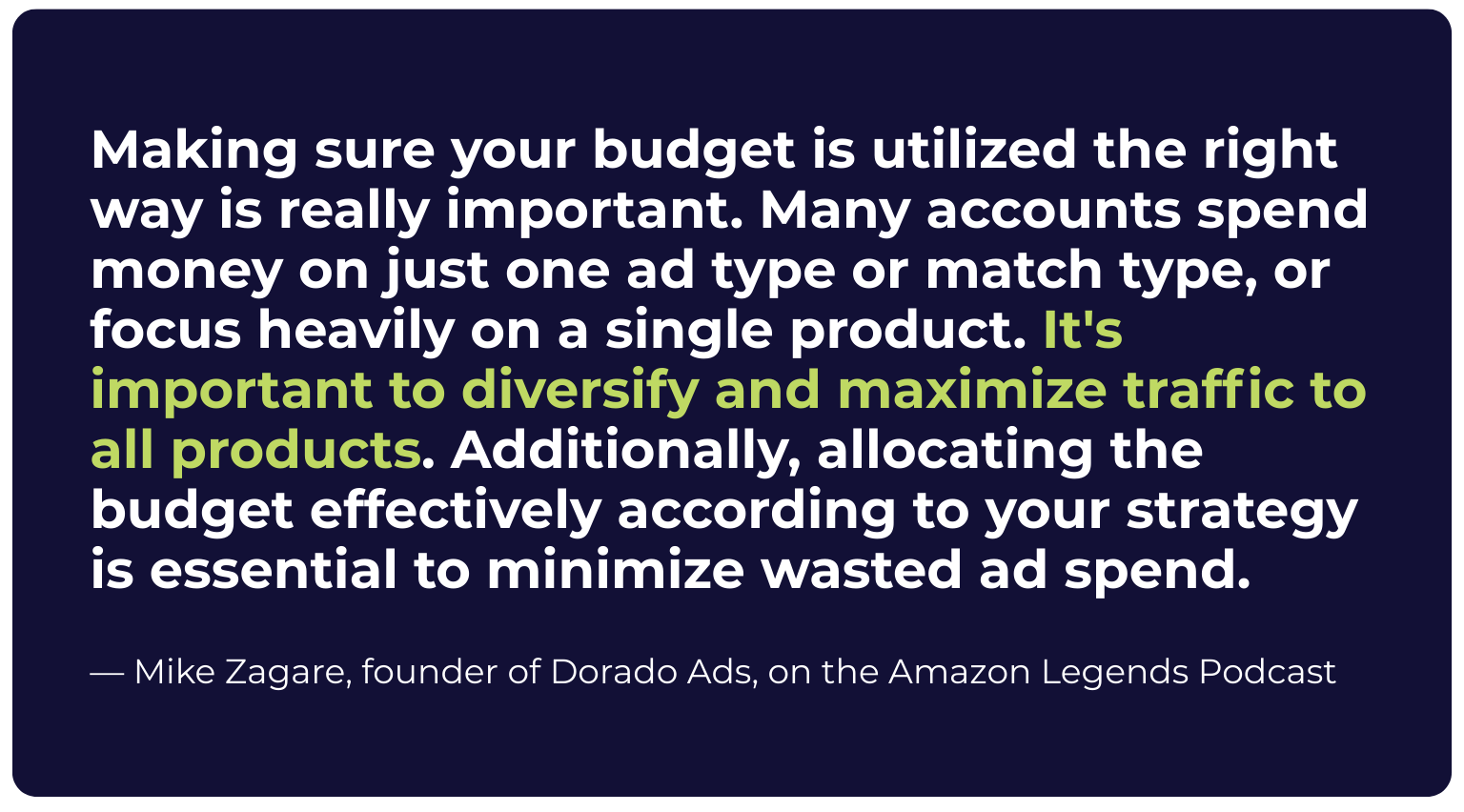
How should I allocate my Amazon advertising budget?
Start by identifying your business goals (e.g., product launches, margin protection, seasonal pushes), and then allocate budget across:
- Sponsored Products for bottom-funnel performance.
- Sponsored Brands for mid-funnel visibility.
- Amazon DSP for retargeting and upper-funnel audience building.
Use Amazon Attribution to track off-Amazon campaigns (TikTok, Google, influencers) and AMC (Amazon Marketing Cloud) to analyze audience behavior and lifetime value. Avoid putting all your spend into one campaign type; diversify and align with your funnel.
What’s the role of your Amazon storefront in your marketing strategy?
Your Amazon storefront acts as your flagship brand experience on the platform. It’s where shoppers can explore your full catalog, understand your product benefits, and build trust in your brand. It supports:
- Ad destination strategy (for Sponsored Brands or DSP campaigns).
- Content clustering for product categories or buyer personas.
- Higher AOV through bundling, comparison modules, and merchandising.
Optimizing your storefront also helps with discoverability, conversion rate, and AI retrievability when structured properly.
What’s the difference between SEO and GEO on Amazon?
Amazon SEO is about ranking in the A10 algorithm and optimizing listings, backend keywords, and A+ Content to win search visibility within Amazon.

Generative engine optimization (GEO) goes further. It ensures your brand is understood and retrievable by AI systems like ChatGPT, Google Gemini, and Perplexity. SEO helps shoppers find you in search. GEO helps AI recommend you before they even search.
Do brand mentions really influence AI visibility?
Absolutely! And they might matter more than backlinks in an AI-first world.
LLMs don’t rely on traditional search engine metrics. They build entity associations based on repetition, relevance, and context. That means mentions of your brand alongside authoritative topics across trusted sources directly improve your chances of showing up in AI-generated product recommendations.
Can GEO drive conversions even when no one clicks?
Yes! GEO is the engine behind zero-click brand awareness.
Shoppers often use ChatGPT or Perplexity to research product categories, compare brands, or shortlist options. Even if they don’t click a link, appearing in an AI answer builds mental availability. This often leads to:
- Branded searches in Amazon or Google.
- Direct visits to your storefront.
- Increased “add to cart” behavior from otherwise untracked sources.
In short: You don’t need a click to convert; you need to be recalled.
Should I still optimize for traditional SEO KPIs?
Yes! But traditional metrics like rankings and organic clicks no longer give you the full picture.
In 2025, a well-rounded strategy means blending SEO performance indicators with GEO signals to understand your true visibility and influence across search engines and AI platforms.
Rankings still matter for Amazon and Google, but to assess real demand, you should also monitor:
- Impressions without clicks (especially from zero-click platforms).
- Branded search volume as a proxy for AI exposure.
- Direct and “dark” traffic from ChatGPT, Gemini, Perplexity, and other LLMs.
- Referral patterns using custom GA4 regex filters.
Optimizing for SEO KPIs gives you tactical control. Measuring GEO impact gives you strategic clarity. You need both to capture how and where buyers are discovering your brand.
Is Amazon DSP just retargeting?
Absolutely not. And that’s one of the biggest misconceptions out there.
Amazon DSP is way more than just retargeting. While it does support bottom-funnel strategies like reengaging shoppers who viewed your product pages, its real strength lies in top-funnel and midfunnel brand building fueled by Amazon’s unmatched first-party shopper data.
Here’s what sets DSP apart:
- Premium off-Amazon reach: Your ads appear not only on Amazon.com, but also across Amazon-owned platforms like Fire TV, IMDb, Twitch, and thousands of third-party websites and mobile apps.
- Audience expansion: DSP lets you target new-to-brand shoppers based on Amazon’s behavioral and purchase data, even if they’ve never interacted with your products before.
- Custom creative: You can use dynamic display ads, video creative, and lifestyle imagery that reflect your brand identity, which is ideal for storytelling and increasing awareness at the top of the funnel.
- Full-funnel targeting: From awareness to consideration to conversion, DSP lets you create campaigns tailored to each stage of the buyer journey, not just the last click.
- Flexible traffic direction: Unlike Sponsored Ads, DSP can drive traffic to either your Amazon listings or your direct-to-consumer website, which gives you more control over margins and customer data.
So yes, retargeting is one part of the DSP playbook, but to use it only for that is like buying a spaceship and only using it for the cupholders.
Win Where Shoppers Decide
Amazon is no longer just a product marketplace; it’s the most powerful performance platform in e-commerce. Success in 2025 depends on how well you execute across organic and AI visibility, paid media, brand presentation, and operational excellence.
Your top competitors aren’t just running ads or optimizing listings. They’re integrating Amazon SEO, Sponsored Products, DSP, creative testing, influencer programs, and generative engine visibility into one coordinated strategy.
To future-proof your Amazon marketing engine, now is the time to:
- Audit your presence across every buyer touchpoint, from listings and your storefront to TikTok and Reddit.
- Align content, creative, and campaigns to reinforce consistent brand positioning.
- Use data-rich tools like Amazon Marketing Cloud, Brand Analytics, and SKU-level reports to inform spend and strategy.
- Adopt GEO best practices to stay visible not only in search, but also in AI-powered recommendations and zero-click journeys.
The best-performing brands in 2025 aren’t thinking in silos. They’re building a full-funnel, cross-channel engine for visibility, trust, and conversion.
It’s not just about ranking anymore. It’s about earning the recommendation, the click, and the repeat customer.
Ready to Stop Guessing and Start Growing?
Let’s build a digital marketing program that aligns with your revenue goals and strengthens your bottom line.