
Google Quietly Killed the &num=100 Parameter. Here’s Why Your Rankings and Impressions Just Got Weird.
Google Quietly Killed the &num=100 Parameter. Here’s Why Your Rankings and Impressions Just Got Weird.
Tony Patrick, Senior Director of SEO • Intero Digital • September 23, 2025
Have your SEO dashboards been acting up lately? Rankings mysteriously capped at page 2, impressions dropping off a cliff, and fewer keywords showing in Search Console? It’s not just you.
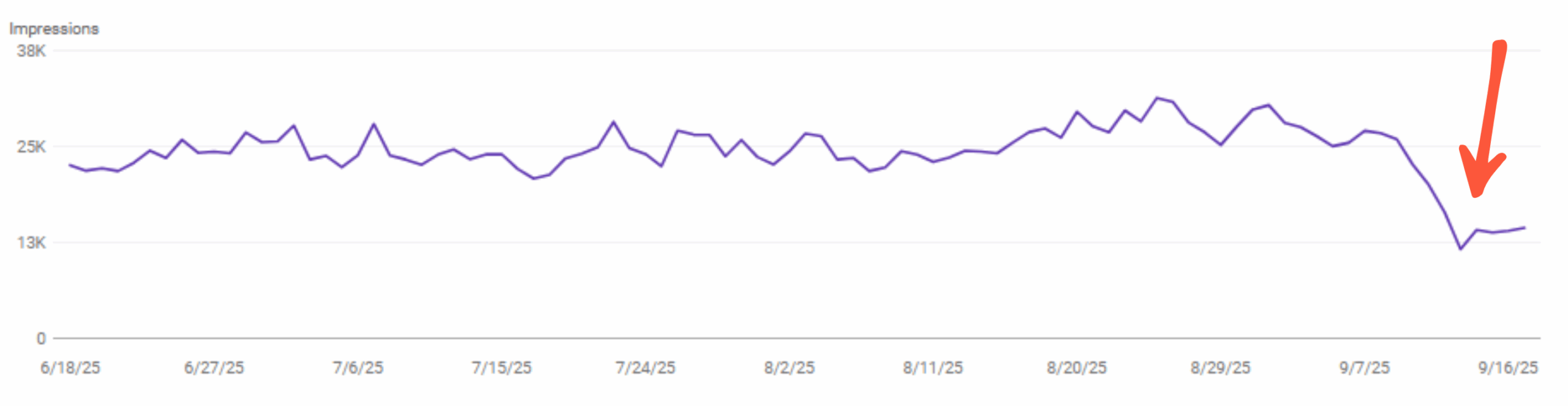
Google quietly deprecated the &num=100 parameter, which many SEO tools and professionals relied on to view and track the top 100 organic results on search engine results pages (SERPs). This seemingly small change has had a big impact on how keyword rankings and impression data are gathered, and it’s throwing a wrench into SEO tracking across the board.
Need some support to succeed in search?
What Is the &num=100 Parameter, and Why Did It Matter?
Historically, appending &num=100 to a Google search URL allowed users (and bots) to see up to 100 organic search results on a single page. This feature was crucial for:
- Comprehensive rank tracking. Tools could check where your site ranked beyond the first page.
- SERP scraping efficiency. Collecting more data in fewer queries meant more reliable data.
- Impression count accuracy. Search Console could attribute impressions to positions beyond page 2.
But as of September 2025, this functionality has disappeared. Google now appears to be limiting the retrievable results to the top 20 (in some cases even fewer), effectively capping SERP visibility from an analytics perspective.
And as Bright Vessel puts it: “This change significantly disrupts SEO tools that relied on retrieving more than 10-20 results per query. Some tools are scrambling to adapt, while others are seeing their rank tracking severely compromised.”
What This Means for SEO Tracking (and Why Your Data Looks Wrong)
If your rank tracking tools suddenly show most keywords maxing out around position 20 (or missing entirely), this is likely why.
Here’s what’s happening:
- Incomplete ranking data: Keywords that previously ranked on pages 3-10 may now be missing from your reports entirely.
- Skewed impression data: Google Search Console is no longer showing impressions for keywords ranking lower in the SERPs, even though users might still be seeing or searching those terms.
- False sense of ranking improvement: Some tools are “guessing” or showing “not ranked” for lower-position keywords, which makes it look like you’ve either dropped off or improved when, in reality, the tool just can’t see the full SERP anymore.
Google's Move Toward Simplicity (or Obfuscation?)
From Google’s perspective, this change might be about streamlining data delivery, reducing load, or pushing users toward a more curated SERP experience (especially as AI Overviews and generative results take up more space).
But for SEOs, the impact is clear: less data, fewer insights, and more uncertainty.
And let’s be honest: When the world’s largest search engine makes a core change without warning and the result is less transparency, it raises questions.
So What Can SEOs Do About It?
While we can’t bring the &num=100 parameter back, we can pivot. Here’s how to respond strategically:
1. Accept That Rank Tracking Is Changing Fast
Treat tools that promise exact positions with skepticism. Use Search Console trends, branded search volume, and AI platform referrals as your north stars instead of chasing precision on page 4 rankings that might never show again.
2. Go Deeper Into the Data You Do Have
Instead of lamenting lost keyword data, double down on what you can see:
- Page-level performance: Which URLs are still pulling impressions and clicks?
- Core topics: What themes or clusters continue to generate visibility?
- AI visibility: Are you appearing in AI Overviews, Gemini, ChatGPT, or Perplexity responses?
This is where blending GEO (generative engine optimization) and SEO becomes crucial. As our recent “search everywhere optimization” playbook explained, it’s about entity presence, brand mentions, and retrievability across AI-powered platforms.
3. Revise Your Keyword Strategy (Relevance > Rankings)
Rather than casting a wide net with hundreds of loosely connected keyword targets, focus on:
- Contextually aligned long-tail terms.
- Entity-rich topics AI tools associate with your brand.
- Keyword clusters that fill content gaps.
But watch out for keyword cannibalization. This new environment means fewer impressions overall, so ensure your pages are supporting one another, not competing.
4. Embrace More Creative Content Discovery
With less visibility into low-ranking keywords, you’ll need to get scrappier.
- Use Reddit, YouTube, TikTok, and Quora to spot emerging questions.
- Mine People Also Ask boxes and AI Overviews topics.
- Look at your site search data and internal analytics for query inspiration.
This shift could actually improve SEO by forcing us to focus on what real users care about, not just what Google shows on page 5.
5. Track AI Mentions, Not Just Google Rankings
Generative search is already here, and it’s not limited by the old “10 blue links” model.
- Use tools (or build custom workflows) to monitor your mentions in ChatGPT, Perplexity, and Gemini.
- Analyze traffic from AI tools using regex filters in GA4.
- Measure branded search lifts. They often signal discovery via AI rather than traditional SERPs.
If you want to future-proof your visibility, you have to start thinking about retrievability, not just rankability. That means being present in the datasets AI relies on to generate answers.
Rankings Are Dead (Sort of), but Relevance Isn’t
Google’s quiet axing of the &num=100 parameter is more than a minor technical change. It’s a signal. We’re moving into a search landscape where visibility is capped, data is streamlined, and AI-driven discovery is becoming dominant.
The tools we relied on are now less reliable. But our north star remains the same: Be relevant, be useful, and be present where discovery happens.
That means:
- Writing with intent.
- Optimizing for retrievability.
- Measuring what matters.
- Staying agile as the search ecosystem continues to evolve.
SEO isn’t broken, but it is different. Adapt accordingly.